

-
How Technology ruined humanity
I have spent a lot of time and effort in the last few months to highlight numerous issues with AI, which…
-
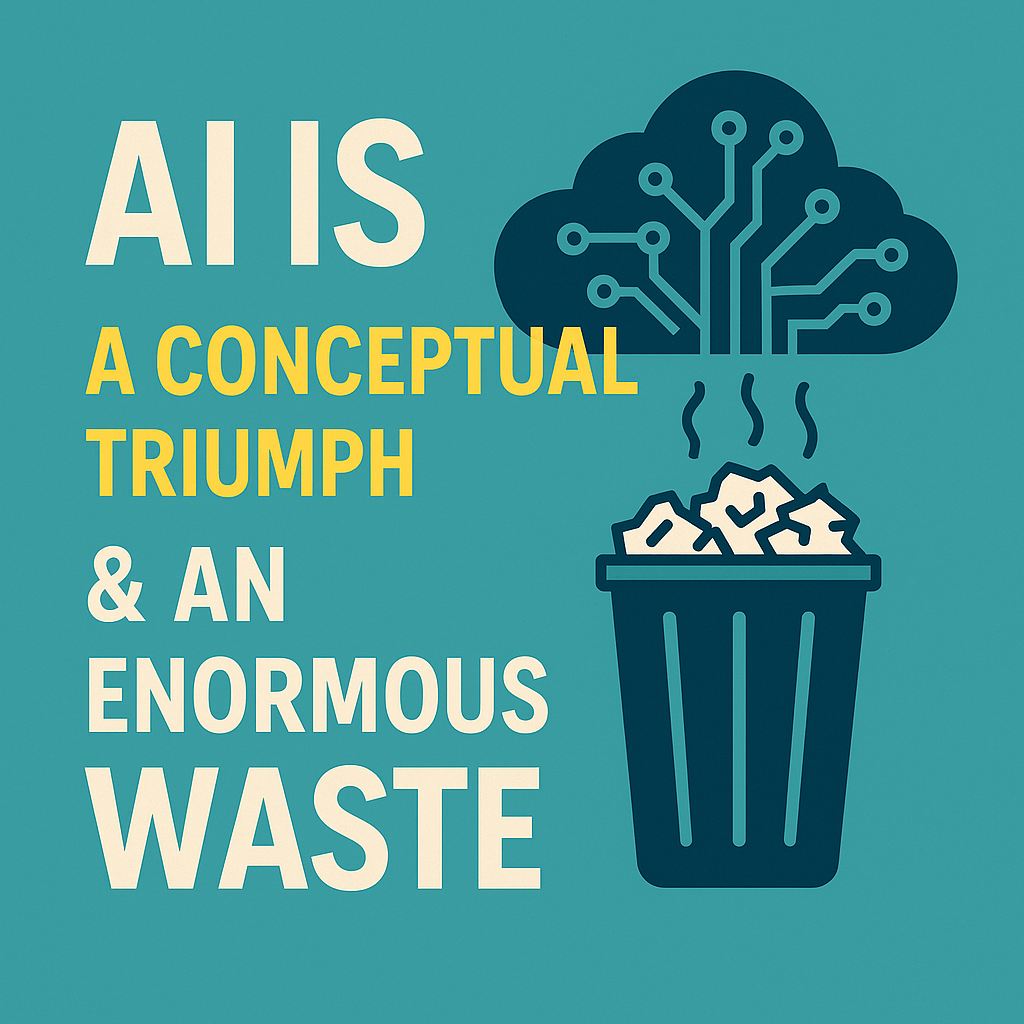
AI is An Ephemeral conceptual triumph & an enormous waste in real life
I keep writing about AI for the simple reason that it’s so complex and different from any other technology in human…
-
AI Will Need More Workers, Not Less
I am sure everyone has by now, read at least a single article about how AI is going to decimate the…
-
Does AI have a future?
No, the title is not a joke. But I am sure to most readers it looks like it is because AI…
-
Rush to AI has the fever of the gold rush – but where is the gold?
The current rush to AI is not just spectacular, it’s also spectacularly misguided. you Rush to grab money When there is…
-
A Computer is an unthinking, uncaring Machine. Are you the same?
Welcome to Our Blog Stay updated with expert insights, advice, and stories. Discover valuable content to keep you informed, inspired, and…
-
AI, the new GOD or an ungodly scam?
AI is everywhere. I am sure people are now organizing introductory classes in kindergartens because the future generation has to be…
-
Why Architecture Maturity Assessment?
Do we need yet another framework in IT (Information Technology)? Isn’t there a plethora of them already? That’s a good question,…
-
Are We Witnessing The End Of Applications?
I recently worked at a fintech company that has been in business long before “fintech” was invented. So, the company was…
I keep writing about AI for the simple reason that it’s so complex and different from any other technology in human history that it offers numerous different angles and ways of looking at it. However most of my post are quite predictive in that they imply some kind of general prediction or conclusion about the future of AI.
AI is the Mt. Everest of technologies but one can’t live on MT. everest
And here is this article’s prediction: the technology reached its limit; it produced what Alan Turing would call a “real intelligence” (which I dispute) a computer that is indistinguishable from a real person in terms of intelligent conversation. This is a logical conclusion to a computing evolution that started after the WW II.
And it’s also the end. Not only because the summit has been reachd and there is no logical way to go from here but because the physical and financial limits have been not just reached but are being now breached.
The value of AI is questionable but its resource consumption isn’t
The cost of running AI is so enormous that it will actually stop AI from improving and will force its eventual piecemeal shutdown once the resources, electricity and water get scarcer, and the financial markets crash so that the phony billions of dollars on computer screens available for investment will disappear overnight.
You may be under the impression from the headlines that the renewable energy especially electricity is now so cheap that we can have as much of it as we need. While green energy is cheaper, energy is never cheap. Energy is the core building block of the universe, it doesn’t come cheap.
And energy at the scale AI needs cannot even be built as there isn’t enough space, enough buldozers, machinery, workers, cement and numerous other components (many made from oil including diesel to power all the machinery). Even taking into account all the planned new electrical gigaprojects to supply the power to AI, it will not be enough to actually grow or even maintain AI significantly. In other words AI has hit a hard resource limit.
AI exists due to the enormous available resource in terms of power and hardware. We can imagine the hardware resources to be exhausted at some point in the near future (how many more gigantic datacenters can be built across the planet in a year?), but we don’t need to imagine the power resources being exhausted.
They already, are. The simple fact is that the growth of AI at the current pace (2025) will result in the shortage of electrical power by 2030 (according to Wired). And this will be the end of AI expansion. When the government has to decide who gets the available electricity, a hospital, a city or AI; well, I am sure AI will be last in-line.
AI is too complex and too unstable to be CORE infrastructure
AI is the pinnacle of computing. This pinancle is so complex that even the creators don’t quite understand why it sometimes does what it does. Hallucinations are a good example, but there is more. The internal complexity manifests itself in the enormous appetite for resources, primarily electrical power. This is the basic law of physics (second law of thermodynamics) that growing system complexity demands exponentially more energy to maintain.
Yet, the complexity doesn’t provide stability, firmness, or solidity to a system. The opposite is the case; the more complex a system is, the less stable it is despite all the consumed energy. And so it is with AI.
AI is an ephemeral technology, you cannot see it, touch it, locate it. Nobody can. Here is a couple of basic user issues I have observed in my daily use:
- The thing runs, spins a wheel, but never comes back. You have to realize that it crashed or whatever or has gone on to greener pastures, then you have to create a new session and if that doesn’t work, you have to log out and log in again. The blue screen of death that Microsoft products are infamous for was more user friendly, one knew immediately it was a death knell.
- It produces a file, but if you go to get a coffee by the time you come back 5 minutes later, the file is gone because the session was terminated. AI may have worked 5-10 minutes on the file and now its gone in a blink of an eye.
This makes AI, unstable, unreliable and ephemeral. And “ephemeral” as a core technology, makes AI useless. And we still didn’t even reach the point of the power cuts, which are coming. Then the “ephemeral concept” will take on a whole new level of meaning, ephemeral as in “being offline due to a blackout”.
So let’s recap what AI is from the practical point of view; over-hyped Alexa with an endless appetite for electrical power and a cooling bath when both are becoming scarce. And it’s as reliable as a junkie on a bend.
A traditional resource, a worker, is still more efficient THAN AI
And then we have the real, the actual, human intelligence. Let’s compared it to AI in terms of power consumption. A human brain uses about 0.3 kWh a day. This is a miniscule amount; it’s only about 20% of the whole body’s energy consumption, which is also small. That’s because humans are intelligent, highly thermodynamically efficient agents that evolved while adapting to the environment.
So a 0.3 kWh buys you a fully functional human being with all its senses and capabilities, which may or may not include a Harvard Phd or similar. And what is the equivalent energy consumption of AI? According to ChatGPT: 50–100 megawatt-hours (MWh) per day.
Let’s assume AI is worth 1000 human human minds combined (all coming from different professions to make up the breadth of AI “knowledge”: doctors, teachers, workers, programmers, scientists, investors, etc. etc.), we are not comparing apples to apples but apples to “artificial apple-look-alikes” just to get baseline.
Then let’s multiply 0.3 kWh x 1000 = 300 kWh. 50–100 MWh is about 170 to 330 times as much energy as 300 kWh, in other words AI uses roughly 170,000 to 330,000 worth of human brain energy. Does anybody think that AI is worth more-or-less 200,000 people, but without arms, legs, eyes, ears?
200K-300K people can build a country (Iceland comes to mind), conquer a country (Grenada?), built pyramids, and what can AI do? Possibly hallucinate the whole time, or come-up with false conclusions, or conclusions not supported by evidence or simply crash in a never-ending spinning wheel.
That’s why humans rule the planet and AI never will.
Leave a Reply