

-
Is Patriotism Good For Business?
If you are an influential, high-ranking business person, have you ever asked yourself this question: Should my business decisions be influenced…
-
20 Years Into Cloud And Still Hardly Anyone Fully Understands It
If there has been one overriding theme to IT delivery in the last 20 years, surely it’s been “it’s the cloud,…
-
How Agile Lost Its Mojo
When the word “agile” was plucked from obscurity in 2001, when the Agile Manifesto was published, it was a very clever…
I am sure everyone has by now, read at least a single article about how AI is going to decimate the workforce. The articles go from sad, lamenting the new world of worklessness, to apocalyptic, predicting a workforce reduction of 30, 40, 50% within the next decade, implying widespread hunger and homelessness.
We have seen this story before, it always resurfaces when new technology seems to be gaining steam faster than the population is ready to accept it (CD technology didn’t cause this). It goes back to the Luddites in the 19th century who destroyed their machines in order to preserve the tedious, numbing, low-paid work in fabric mills for themselves and their coworkers.
Hardly a decade goes by without the same old fears resurfacing due to the introduction of simple factory automation in the seventies, or basic office computing in the eighties, or more advanced Japanese-type full factory automation in the nineties, or more advanced workflow office computing in the late nineties, and so on.
Each time, there is an acknowledgment in these articles of prior similar fears that failed to materialize, but each time the writer claims, “this time is different”, “this time it’s for real”.
Really?
My Basic Law Of Computing
Let me introduce my law of computing that I observed over my 30 years in business. It’s somewhat like Moore’s law, which is now obsolete (roughly since 2016 according to a MIT professor), only much more durable and important. It doesn’t simply predict a single feature, such as the power of a computer; it predicts social and economic needs for the future based on the evolution of computing. It’s therefore much more practical and useful.
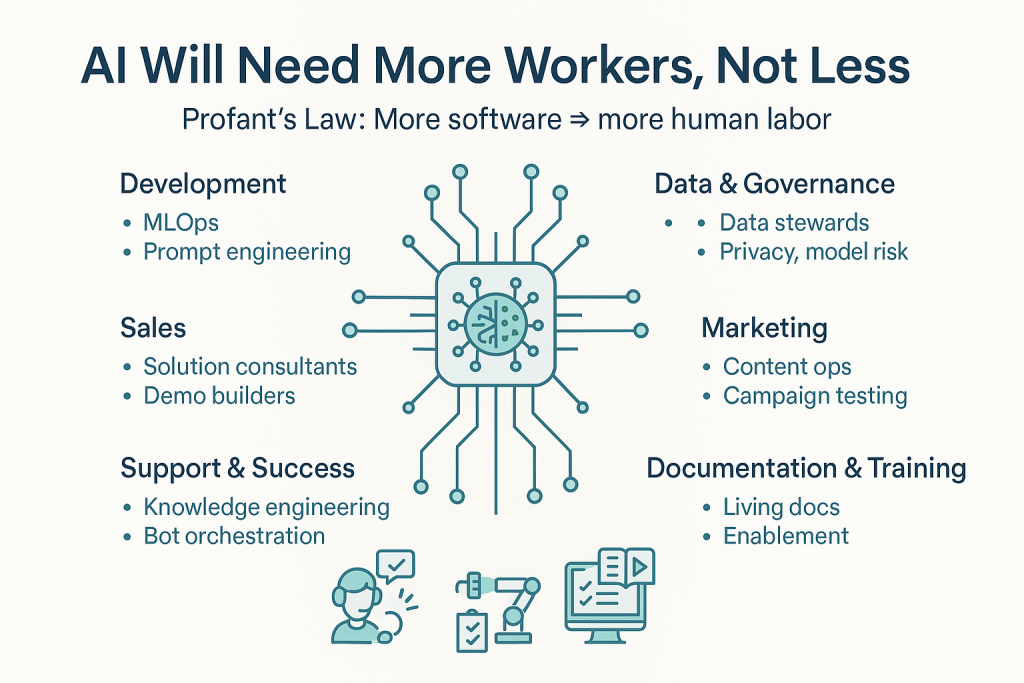
Let’s call it the “Profant law of the necessary increase in human labour required proportional to the increase in software functional footprint globally”. In simple words, it says, “The more software is developed, the more workers are required to develop and manage it”. And the kicker is: there is always more software being developed.
Let’s break this down. Far from technology and specifically IT technology eliminating jobs, it’s a net new job creator. While any specific technology may eliminate some (even a good number) of low-level positions in an office or a factory, it creates more positions in the technology delivery pipeline which are higher-level positions with better pay and more skills.
Therefore, any introduction of a significant transformational technology doesn’t eliminate jobs, it transforms them and creates more of them.
The real social and political issue is not the elimination of jobs, but the elimination of low-skill jobs. But this is a socio-economic topic, which is very important, but outside of the scope of this blog.
The fear throughout history that technology will eliminate human labour is based on a fundamental misconception of “work”. If “work” is limited to a specific number of tasks required as it is in each factory or an office then it makes sense to fear loss of jobs to automation; because once all the gadgets have been built by robots, no human labour is necessary, just as in the office, when all the letters and accounting have been done by AI, there is no need for office workers.
However this understanding of “work” is completely false. It conflates “universal work” with specific local set of tasks.
Universal Truth About the Nature of “Work”
The universe is a “work in progress” even if it is in the mind of God as some believe; the amount of “available work” in the universe is unlimited, even if the universe itself is limited (there is still a debate about this). The only limit on the “actual work” in the universe is the amount of available resources, including labour (machine and human).
Therefore, it’s not the amount of work that limits the labour but the opposite; the amount of available labour limits the amount of work done, which is a small subset of work available.
Let’s look at some evidence for these bold claims.
- Developing countries have the highest level of unemployment and the lowest level of automation.
- The developed countries have high levels of automation and low (EU) to very low (USA) levels of unemployment. Even Spain with official unemployment close to 20% is a haven for African economic migrants.
- Automation increases profits, which are then reinvested in business, creating new opportunities and jobs in general. This is a completely natural economic cycle and doesn’t need any external stimulations (but it does need a certain environment, such as a neutral legal framework).
- Look around your household, do you see a limited amount of work that needs to be done, which, once done, is done forever? You can always renovate your kitchen, bathrooms, repaint, remodel bedrooms, redesign your front and backyard, build a dog house (as a summer cottage, a dog should live inside), install a spa, etc., etc. But guess what? Even if you have done all that already, by that time, you’re done, your kitchen has aged, and you can start again.
I can bring this whole argument to an inarguable end by stating that “work is necessary and always being created because of the Second Law of Thermodynamics, also known as Entropy”.
Is Labour going to be disrupted by AI? Certainly, but in the long term, the more AI is used, the more human labour will be needed.
Leave a Reply