

-
Is Patriotism Good For Business?
If you are an influential, high-ranking business person, have you ever asked yourself this question: Should my business decisions be influenced…
-
20 Years Into Cloud And Still Hardly Anyone Fully Understands It
If there has been one overriding theme to IT delivery in the last 20 years, surely it’s been “it’s the cloud,…
-
How Agile Lost Its Mojo
When the word “agile” was plucked from obscurity in 2001, when the Agile Manifesto was published, it was a very clever…
I have spent a lot of time and effort in the last few months to highlight numerous issues with AI, which I call FAI (False AI). To put it succinctly, FAI is a enormous intellectual achievement that has come about at the tremendous financial costs (easily a trillion +) never seen before in human existence and which will continue to rise if allowed. Yet FAI is impractical, ephemeral, full of possibly insurmountable legal issues (copyright, liability), but above all it comes with a never-ending list of quality issues. Any other product, service would have died a long time ago on the vine, thanks to the combination of these issues, but not FAI. Because FAI is special to the tech bros, it’s a first significant stepping stone to what they call the singularity, whatever that means. And the tech bros now run the world.
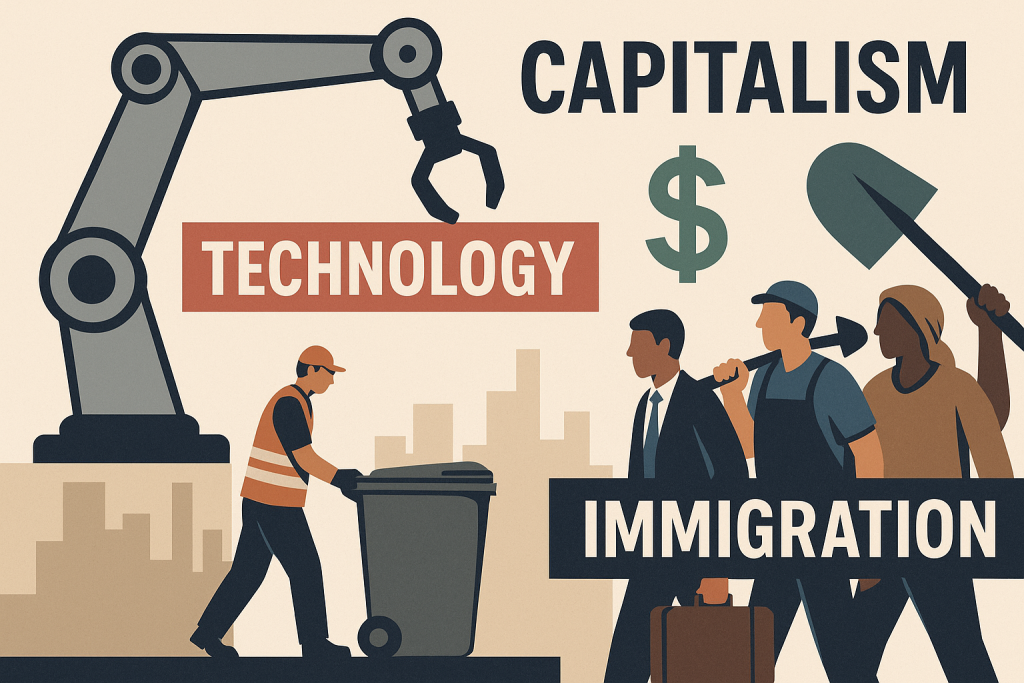
Having said that, I have a bigger fish to fry than FAI. Whilst thinking about FAI, I came to realize that FAI is just another version of tech utopia promised by technology-driven economic system called capitalism. Capitalism has mastered the art and science of production, it can create billions of dollars worth of products a year that nobody wants, needs and will ever buy (clothing worth millions buried in land-fills is a good example). But, it turns out, capitalism is even better at marketing its often worthless wares than producing them. And so for decades we have been fed the constant stream of future technological marvels, self-digging shovels, air-based roadwork used by flying cars, robots performing all home-based chores, robots companions to people and animals, robots flying to far-off planets to bring necessary supplies like metals and ores. Over the decades, I read so many articles telling us that a workless utopia is just around the corner where people will spend their whole lives in leisure because “robots and automation”. Well, it turns out the capitalism predicting these “wonderful” things was just a little spatially-challenged, the techno bonanza wasn’t around the corner but over the horizon. And the horizon can never be reached because it’s relative to your position, unlike a corner.
And this is where we are. The easy technology-driven life never materialized and never will, I think we can now safely say that. But it’s not just that the fairy tales are turning out to be just that, fairy tales. People adopted attitudes and lifestyles (whole mindsets) to fit this future promised by capitalism. Even worse, societies organized themselves accordingly only to find out that it was all a delusion. There is little robotization in the society; there is some automation but it’s not significant. It was expected that all the dirty menial work would be done by machines, hardly any is. From Reykjavik to Cape Town garbage is still picked up by people, except in the west, nobody wants to be a “garbage collector” and so the western countries have to import foreign workers to pick up their garbage. The garbage business is just the most obvious one, but all low-paid menial work has very few takers in the West. And so the West has become the largest migration machine in the history of humanity, not because it cares about foreigners, it doesn’t, but because the foreigners will do the work its own native citizens don’t want to do.
But importing foreign workers is becoming more and more problematic as the foreigners look less and less like natives and so do their cultures. Germans could swallow Turkish workers by millions because the Turks were white and semi-European since they ruled large parts of Europe for centuries. And besides, they didn’t get to stay in Germany, they only received a temporary working Visa. Well, that didn’t work out as the Turks stayed for good, but that’s exactly my point.
The West was fed capitalist utopia of leisure due to lack of work. So europeans naturally adopted the world view that we don’t need children to take care of us in our old age, we will have robots to serve us and the government to pay for it. Besides, children have become liabilities. In the previous economic system, even a primitive capitalist one, children were always an asset, they could make you money. In late-stage capitalism children have become the highest liability there is. They don’t make money for the family except for the low government support payments which go into hundreds of dollars, Euro, whatever. When an actual child rearing over the 20 year period goes into tens and hundreds of thousands of dollars or euro, despite free schooling and healthcare.
In other words, the basic economic calculus of having children has changed over the last few decades from being heavily in favour of children to being heavily against the children. No government seems to understand that, not German, not Italian, not Russian. You cannot bribe people to have children unless the bribe is so large that it reverses the calculus. But no government has that kind financial power, as most governments run on deficits to support the adult population, never mind the children.
I have gotten away from my point, which is simple: capitalism-driven technological society has created expectations about the future that it didn’t meet. The technology hasn’t automated much of people’s lives, yet created the expectation that all the low-end manual work will be done by robots and hence no future working class or even own children are required. Then logically, the society didn’t produce much of a future working class, which now has to be imported from the rest of the world at a high cost and enormous social costs (natives voting for the right-wing parties supporting a stop to immigration).
The obvious conclusion is that the West bet on capitalist technology, which promised the elimination of low-paid manual labour over time. This hasn’t happened in any significant sense, and so the West now has to rely on importing the labour it needs and doesn’t have, to perform its basic maintenance functionality like collecting garbage. This creates an enormous social and cultural friction as civilizations clash over everything from dress code, to food, to religious rituals, to the support of foreign political and social agendas and governments.
To conclude, let me emphasize that I only addressed one driver in this article, the inherent need in Europe for immigration. I didn’t address the second inherent driver, the need for Africa and Middle East for emigration. This is completely different but complementary to the European and North American immigration needs.
Leave a Reply